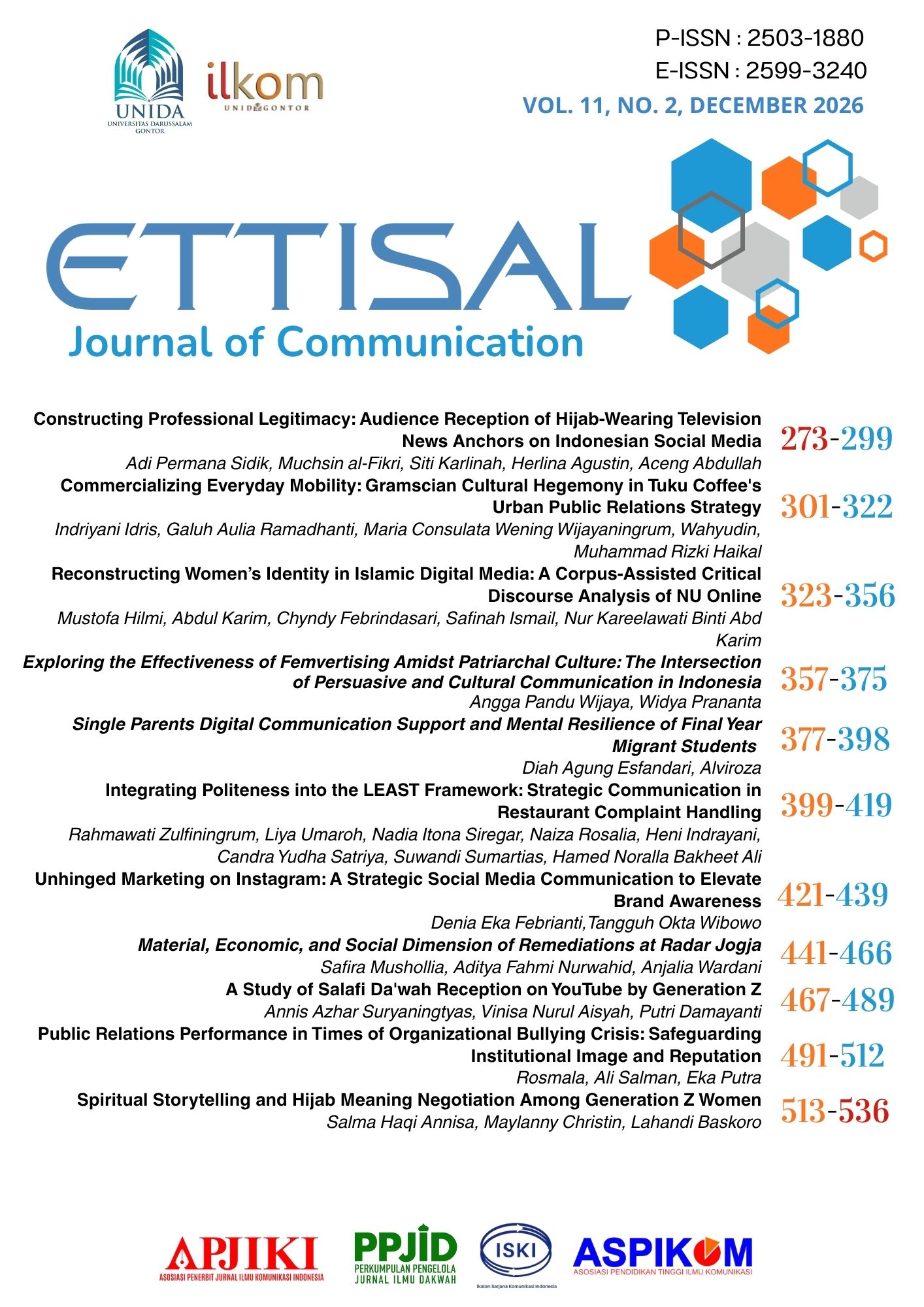
A Study of Salafi Da'wah Reception on YouTube by Generation Z
DOI:
https://doi.org/10.21111/ettisal.v11i2.105Keywords:
Digital Salafism, Audience Reception Theory, Generation Z, YouTube Da'wah, Khalid Basalamah, Islamic CommunicationAbstract
Digital media has increasingly facilitated the spread of Salafi da’wah, enabling traditionalist conservative discourses to reach broader and younger demographics. Despite persistent socio-religious stigmas surrounding Salafism, its digital outreach has gained significant traction among Generation Z. Drawing on Stuart Hall’s Encoding/Decoding model, this study investigates how Gen Z audiences interpret and negotiate digital Salafi preaching, focusing on Ustadz Khalid Basalamah’s YouTube series on Major Sins (Dosa-Dosa Besar). Employing a qualitative reception approach, data were gathered through in-depth interviews with 11 Gen Z viewers (born 1997–2012) selected via purposive sampling, complemented by textual and visual observations of the five most-viewed videos in the series. The findings reveal two primary audience reception positions: (1) Dominant-Hegemonic (8 informants), driven by high perception of the preacher’s authority, strict adherence to textual sources (Qur’an and Hadith), and the accessibility of YouTube features (playlists, live streams, and short clips); and (2) Negotiated (3 informants), shaped by critical cross-referencing with alternative religious scholars, independent textual verification, and resistance to treating a single penceramah as an absolute authority. Notably, no informants occupied an oppositional reading position. This study demonstrates that digital Salafi da'wah successfully bridges conservative theology and youth culture through perceived textual authenticity and algorithmic media optimization.
References
Aditia, R., & Ritonga, M. H. (2024). Analisis Pesan Dakwah Ustadz Khalid Basalamah “Membangun Keluarga Islami” di Media Sosial Instagram (Vol. 9, Number 2). https://journal.iaincurup.ac.id/index.php/jdk/index
Adz-Dzahabi, A.-H., & Kandir, N. (n.d.). DOSA-DOSA BESAR *** ُ.
Ahmad Atabik. (2014). KONSEP KOMUNIKASI DAKWAH PERSUASIF DALAM PERSPEKTIF AL-QUR’AN.
Allisa, L., & Triyono, A. (2023). Pengaruh Dakwah di Media Sosial Tiktok Terhadap Tingkat Religiusitas Remaja di Demak. Jurnal Ilmu Komunikasi, 7(1), 26–38. https://doi.org/10.30596%2Finteraksi.v7i1.13070
Al-Zaman, M. S. (2021). A content analysis of social media users’ reaction to religious disinformation in Bangladesh. Library Philosophy and Practice (e-Journal). https://digitalcommons.unl.edu/libphilprac
Ammar Ramzi. (2023). Ini 5 Ustaz yang Pengajiannya Pernah Ditolak Banser atau GP Ansor, mulai dari Khalid Basalamah hingga Abdul Somad . Https://Www.Tvonenews.Com/Berita/Nasional/107174-Ini-5-Ustaz-Yang-Pengajiannya-Pernah-Ditolak-Banser-Atau-Gp-Ansor-Mulai-Dari-Khalid-Basalamah-Hingga-Abdul-Somad.
Angger Bimantara, & Fikri Zuhriyah, L. (2022). STRATEGI DAKWAH KEPADA KELUARGA (Studi Pemikiran Tokoh Dakwah Ustaz Khalid Basalamah). Al-Majaalis: Jurnal Dirasat Islamiyah, 9(2).
Averus Kautsar. (2024). Makin Banyak Remaja RI yang Seks Sebelum Nikah, Bisa Seserius Ini Dampaknya . Health.Detik.Com.
BBC Indonesia. (2019). Ustaz Firanda ditolak di Aceh karena “lebih cenderung ke Wahabi” dan untuk mencegah “kekacauan masyarakat.” Bbc.Com.
Bruhn Jensen, K. (n.d.). A Handbook of Media and Communication Research: Qualitative and quantitative methodologies.
Chozin, M. A. (2013). STRATEGI DAKWAH SALAFI DI INDONESIA. In Jurnal Dakwah: XIV (Number 1).
CNN Indonesia. (2024). Ditolak Ansor, Syafiq Basalamah Isi Kajian di Purimas Sejak 2017. Cnnindonesia.Com.
Damayanti, M., & Pierewan, A. C. (2016). PRASANGKA SOSIAL TERHADAP SALAFI DI YOGYAKARTA. In Jurnal Pendidikan Sosiologi UNY.
Dawood, I. (2020). Who is a “Salafi”? Salafism and the Politics of Labelling in the UK. Journal of Muslims in Europe, 9(2), 240–261. https://doi.org/10.1163/22117954-12341416
Elmasry, S. (2010). The Salafis in America: The rise, decline and prospects for a Sunni Muslim movement among African-Americans. Journal of Muslim Minority Affairs, 30(2), 217–236. https://doi.org/10.1080/13602004.2010.494072
Emmerich, A. (2020). Salafi youth activism in Britain: A social movement perspective. In Journal of Muslims in Europe (Vol. 9, Number 3, pp. 273–303). Brill Academic Publishers. https://doi.org/10.1163/22117954-BJA10009
Faddilla, F., & Rusdianto, R. (2024). Perencanaan Konten Kreatif Dalam Campaign “The Portal” Untuk Meningkatkan Awareness Gen Z Pada Pilkada 2024. Jurnal ISO: Jurnal Ilmu Sosial, Politik Dan Humaniora, 4(2), 6. https://doi.org/10.53697/iso.v4i2.2105
Fajaruddin Patma, O., & Djuni Prihatin, S. (2025). Analisis Resepsi Stuart Hall Tentang Poster Silang Pinjam Antar Perpustakaan Sepatu Jolifa. Abdi Pustaka: Jurnal Perpustakaan Dan Kearsipan, 5(1). https://doi.org/10.24821/jap.v5i1
Frost, J. K., & Youngblood, N. E. (2014). Online Religion and Religion Online: Reform Judaism and Web-Based Communication. Journal of Media and Religion, 13(2), 49–66. https://doi.org/10.1080/15348423.2014.909190
Hall, S. (n.d.). Encoding/Decoding.
Heidi A. Campbell. (2023). The Dynamic Future of Digital Religion Studies (7). Koninklijke Brill NV, Leiden, The Netherlands.
Helmy, M., Ayuni, R. D., Islam, U., Muhammad, K., & Al-Banjari Banjarmasin, A. (2019). KOMUNIKASI DAKWAH DIGITAL: MENYAMPAIKAN KONTEN ISLAMI LEWAT MEDIA SOSIAL LINE (STUDI DESKRIPTIF PADA AKUN LINE 3SAFA) (Vol. 2).
Ho, S. S., Lee, W., & Hameed, S. S. (2008). Muslim surfers on the internet: Using the theory of planned behaviour to examine the factors influencing engagement in online religious activities. New Media and Society, 10(1), 93–113. https://doi.org/10.1177/1461444807085323
Indah Fitrah Yani. (2026). Survei Ungkap Hanya 38,9% Muslim Indonesia Selalu Salat 5 Waktu. Detik.Com.
Janet Staiger. (2005). Media reception studies. New York University Press.
Joko Sadewo. (2023). ‘Hamil Duluan’ dan Pendidikan Seks Gen-Z.
Kholis, N., Puspitasari, E., & Soedirman, U. (2023). Dinamika Gerakan Dakwah Salafi pada Masyarakat Multikultur di Indonesia. Jurnal Pendidikan Dan Studi Islam, 4(2), 52. http://jurnal.staiddimakassar.ac.id/index.php/aujpsi
Kulsum, U., Subhan, A., & Darajat, D. M. (2021). VIRTU: JURNAL KAJIAN KOMUNIKASI, BUDAYA DAN ISLAM PRAKTIK DAKWAH ONLINE DI MEDIA SOSIAL (STUDI KASUS PADA AKUN INSTAGRAM @KHALIDBASALAMAHOFFICIAL). Virtu: Jurnal Kajian Komunikasi, Budya Dan Islam, 1(1). http://journal.uinjkt.ac.id/index.php/kpi
Muhammad Anshar, Asni Djamereng, & Muh. Ilham. (2024). Content Analysis and Audience Receptions of Online Da’wah on YouTube Social Media. Jurnal Komunikasi: Malaysian Journal of Communication.
Nightingale, Virginia. (2011). The handbook of media audiences. Wiley-Blackwell.
Purnama, R. F. (2020). THE AESTHETIC RECEPTION OF THE QURAN IN INSTAGRAM: Variations, Factors, and Religious Commodification. ULUL ALBAB Jurnal Studi Islam, 21(2), 237–268. https://doi.org/10.18860/ua.v21i2.9528
Qadaruddin, M., & Bakri, W. (2022). Postmillenial Netizens’ Reception of Da’wah Messages on Social Media. In KOMUNIKA: Jurnal Dakwah dan Komunikasi − (Vol. 16, Number 2).
Rahmat Julian Sudirman, Dadang Syaripudin, & Moch Mahbub. (2024). Hukum Mendengarkan Musik dan Nyanyian Menurut Muhammad Al-Ghazali Dan Abd Al-Aziz bin Baz. Jurnal Madzhab, (1).
Rane, H. (2022). Interfaith Actor Reception of Islamic Covenants: How ‘New’ Religious Knowledge Influences Views on Interreligious Relations in Islam. Religions, 13(9). https://doi.org/10.3390/rel13090873
Rastati, R. (2018). MEDIA LITERASI BAGI DIGITAL NATIVES: PERSPEKTIF GENERASI Z DI JAKARTA. Jurnal Kwangsan, 6(1), 60. https://doi.org/10.31800/jtp.kw.v6n1.p60--73
Raudah, S. F., Arief, Y., & Rahman, A. A. (2023). ABU ZAYD AL-BALKHI’S PERSPECTIVE ON DEPRESSION AND ANXIETY IN “MASALIH AL-ABDAN WA AL-ANFUS.” Psikis : Jurnal Psikologi Islami, 9(2), 302–311. https://doi.org/10.19109/psikis.v9i2.19621
rzr. (2019). Salafi ala Basalamah dan Hijrah Kaum Muda Takut Dosa. CNN Indonesia.
Santoso, W., & Irfanudin, F. (2023). Analisis Pesan Dakwah pada Akun Instagram @bagasmaulanasakti. Komunida: Media Komunikasi Dan Dakwah, 13, 1–20. https://doi.org/10.35905/komunida.v7i2
Souleimanov, E. A., & Schwampe, J. (2017). Devout Muslims or tough highlanders? Exploring attitudes toward ethnic nationalism and racism in Europe’s ethnic-Chechen Salafi communities. Journal of Ethnic and Migration Studies, 43(15), 2616–2633. https://doi.org/10.1080/1369183X.2017.1287560
Sounaye, A., & Orient, L.-Z. M. (2017). Salafi revolution in West Africa.
Tri Mutiara. (2023). METODE DAKWAH USTADZ KHALIDdBASALAMAH DIiAKUN YOUTUBEeKHALID BASALAMAH OFFICIAL. Jurnal Komunikasi, 1(4), 170–182.
Triyono, A., & Marhuda, N. K. (2020). Studi Analisis Isi Pesan Dakwah Dalam Media Sosial Instagram @dakwah_tauhid. Jurnal Interaksi : Jurnal Ilmu Komunikasi, 4(1), 50–67. https://doi.org/10.30596/interaksi.v4i1.3944
Usman, U., & Siagian, H. F. (2024). Indonesian Younger Generation’s Acceptance of Digital Da’wah. Jurnal Dakwah Risalah, 35(1), 1. https://doi.org/10.24014/jdr.v35i1.28975
Wahyudin. (2021). MENYOAL GERAKAN SALAFI DI INDONESIA (Pro-Kontra Metode Dakwah Salafi) Wahyudin. 2.
Submitted
Accepted
Published
Issue
Section
License
Copyright (c) 2026 Annis Azhar Suryaningtyas, Vinisa Nurul Aisyah, Putri Damayanti

This work is licensed under a Creative Commons Attribution-NonCommercial-ShareAlike 4.0 International License.
Ettisal: Journal of Communication is committed to the principle that making research freely available to the public supports a greater global exchange of knowledge.
All articles published in Ettisal are open access and freely available online immediately upon publication, without any subscription or access fees. Readers are allowed to read, download, copy, distribute, print, search, or link to the full texts of the articles, or use them for any other lawful purpose, without asking prior permission from the publisher or the author, provided that the use is non-commercial and the original source is properly cited.
All works published in Ettisal: Journal of Communication are licensed under the Creative Commons Attribution–NonCommercial–ShareAlike 4.0 International License (CC BY-NC-SA 4.0).
This means:
-
Users may share (copy and redistribute) and adapt (remix, transform, and build upon) the material in any medium or format for non-commercial purposes.
-
Appropriate credit must be given to the author(s) and the journal, a link to the license must be provided, and any derivative works must be distributed under the same license.
-
Commercial use of the published material is not permitted without prior written consent from the author(s) and the journal.
Authors retain full copyright to their work and grant Ettisal: Journal of Communication the right of first publication. Authors may also deposit their published articles in institutional repositories or personal websites, acknowledging the journal as the original place of publication.
Through this open access policy, Ettisal: Journal of Communication aims to promote ethical scholarship, knowledge dissemination, and public engagement with communication studies worldwide.