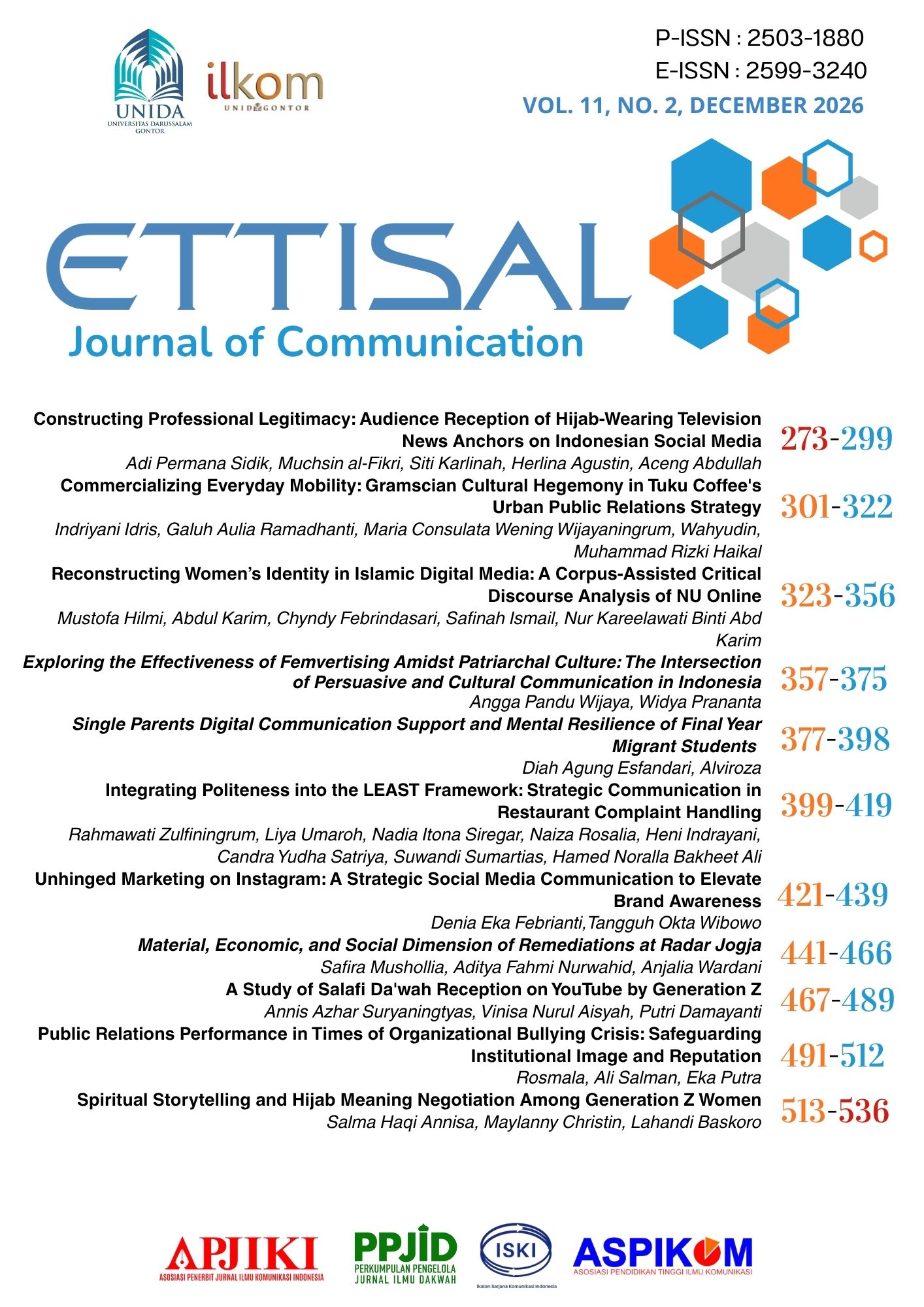
Spiritual Storytelling and Hijab Meaning Negotiation Among Generation Z Women
DOI:
https://doi.org/10.21111/ettisal.v11i2.123Keywords:
Meaning Construction, Hijab, Digital Narrative, Generation Z, InfluencerAbstract
The growth of digital media has positioned influencer narratives as an important source in shaping the social and religious understanding of Generation Z. This study aims to analyze how the reality of hijab is constructed by Generation Z through Jinju’s spiritual journey narrative presented in a YouTube podcast with Leo Giovanni. This study focuses on Jinju’s spiritual experience as a specific case study due to her high audience engagement, which surpasses that of several other hijrah influencers, as well as the openness of her spiritual experience on social media, particularly YouTube. The research employed a qualitative approach using narrative analysis, involving 30 female Gen Z informants aged 18–28 in Serang City and one expert informant from a local Muslim women’s community. Data were collected through in-depth interviews, digital observation, documentation, and literature review, and analyzed using Miles and Huberman’s interactive model of data reduction, data display, and conclusion drawing. The analysis was based on Bruner’s concept of Referentiality. The findings reveal that Jinju’s spiritual journey from anxiety through spiritual searching to transformation provides the narrative structure through which Generation Z women interpret their own experiences and negotiate the meaning of hijab. Most informants, who were already wearing the hijab, received the narrative primarily as affirmation rather than persuasion, while individual interpretations varied according to their religious knowledge, personal histories, and experiences. Through Referentiality, informants related their experiences to Jinju’s narrative and reconstructed hijab reality not merely as a religious obligation or symbol, but as a representation of self-transformation, inner peace, protection, and closeness to God. The study highlights digital influencer narratives as emerging sources of religious meaning-making among Generation Z through active and differentiated processes of audience reception.
References
Andriani, E., Dista Prasetya, A., & Yudha Pratama, B. (2024). Pengaruh Aplikasi TikTok dalam Komunikasi Generasi Z: Tinjauan terhadap Perubahan Pola Interaksi dan Ekspresi Digital. Jurnal Ilmu KomunikAI, Administrasi Publik Dan Kebijakan Negara, 1(3), 42–52.
https://doi.org/10.62383/komunikasi.v1i3.31
Beilin, H., & Puffal, P. B. (1992). Piaget’s Theory : Prospects and Possibilities. (H. Beilin & P. B. Puffal, Eds.). Hillsdale, New Jersey: Lawrence Erlbaum Associates, Inc.
Bruner, J. (1991). The narrative construction of reality. Critical Inquiry, 18(1), 1–21.
Hariyanto, D., & Zam Zami, M. R. (2026). Digitalisasi Kesalehan: Konstruksi Identitas Keagamaan Generasi Z di Media Sosial. Journal of Religion and Social Science E-ISSN: XXXX-XXXX, 1(1), 1–13.
Hasba, H. B., & Hasba, H. B. (2022). The Negotiation of Muslimah Identity in Hijab Cosplay Phenomenon. Jurnal Komunikasi Indonesia, 11(2). https://doi.org/10.7454/jkmi.v11i2.1029
Kaddi, S. M., & Muhaemin, E. (2020). Motif dan Makna Berjilbab Mahasiswi Komunikasi Universitas Tadulako Palu. Communicatus: Jurnal Ilmu Komunikasi, 4(1), 67–84. https://doi.org/10.15575/cjik.v4i1.8652
Lasti Yossi Hastini, Rahmi Fahmi, H. L. (2020). Apakah Pembelajaran Menggunakan Teknologi dapat Meningkatkan Literasi Manusia pada Generasi Z di Indonesia? Jurnal Manajemen Informatika (JAMIKA), Volume 10(April), 12. https://doi.org/10.34010/jamika.v10i1
Littlejohn, Stephen, W., A.Foss, K., & Oetzel, J. G. (2017). THEORIES OF HUMAN COMMUNICATION Eleventh Edition. Waveland Press, Inc. (Vol. 53).
Littlejohn, S. W., & Foss, K. A. (2009). Theories of Human Communication. (R. Oktafiani, Ed.) (Sembilan). Jakarta: Penerbit Salemba Humanika.
Lyansari, K. N. (2018). Hijrah Celebrity: Creating New Religiosities, Branding Economics of Lifestyle in the Age of Muslim Mass Consumption. Analisis: Jurnal Studi Keislaman, 18(2), 211–232. https://doi.org/10.24042/ajsk.v18i2.3066
Muna, A. A. (2020). Religious Expressions of Hijrah Celebrities: Accomodating Protest and The Political Economiy of Public Piety. Islam Realitas: Journal of Islamic and Social Studies, 6(1).
https://doi.org/10.30983/islam_realitas.v6i1.3154
N Vidityas, S., & Nurita, A. (2023). INTERPRETASI HIJAB PUNUK UNTA DALAM PERSPEKTIF RIWAYAT MUSLIM, 2(2), 59–69.
https://doi.org/10.30984/mustafid.v2i2.623
Nasir. (2026). Fenomena Komunikasi Parasosial : Kedekatan Emosional antara Influencer dan Followers di Media Sosial, 2, 15–26. https://doi.org/10.32814/kmdn.v2i1.25
Pingki, A., Aprianto, D., & Yanuarti, M. (2024). Persepsi Gen Z terhadap Ketahanan Pangan di Kabupaten Rejang Lebong Universitas Pat Petulai , Indonesia mengaplikasikan teknologi , sehingga perlu diketahui bagaimana persepsi Gen-Z terhadap, (3).
https://doi.org/10.62951/botani.v1i3.247
Putra, W. S. (2023). Kebebasan Beragama dan Kontroversi Hijab : Sebuah Perspektif Hak Asasi Manusia, 2, 51–63.
https://doi.org/10.59342/jl.v2i1.175
Rizky Aulia, M. M., & Christin, M. (2024). Communication Ethics of Generation Z and Millennial Generation on Tiktok Social Media, 5(3), 1241–1248.
https://doi.org/10.33367/ijhass.v5i3.5966
Sohail, S., Anjum, G., & Aziz, M. (2023). Hijab and enclothed cognition: The effect of hijab on interpersonal attitudes in a homogenous Muslim-majority context. Cogent Psychology, 10(1). https://doi.org/10.1080/23311908.2023.2219084
Sudirman. (2024). Eksplorasi Pengalaman Spiritual Dalam Proses Pemulihan Psikologis Pasca-Trauma. Jurnal Program Studi PGMI, 11(4), 273–280.
https://doi.org/10.69896/modeling.v11i4.2668
Woodward, K. (1997). Concepts of identity and difference. Identity and Difference, 2, 7–61.
Yasa, G. P. P. A. (2022). Analisis Unsur Naratif sebagai Pembentuk Film Animasi Bul. Jurnal SASAK : Desain Visual Dan Komunikasi, 3(2), 48–57. https://doi.org/10.30812/sasak.v3i2.1594
Zis, S. F., Effendi, N., & Roem, E. R. (2021). Perubahan Perilaku Komunikasi Generasi Milenial dan Generasi Z di Era Digital. Satwika : Kajian Ilmu Budaya Dan Perubahan Sosial, 5(1), 69–87. https://doi.org/10.22219/satwika.v5i1.15550
Zhang, L. (2025). The Digital Age of Religious Communication: The Shaping and Challenges of Religious Beliefs through Social Media. Studies on Religion and Philosophy, 1(1), 25–41. https://doi.org/10.71204/de63mn10
Submitted
Accepted
Published
Issue
Section
License
Copyright (c) 2026 Salma Haqi Annisa, Maylanny Christin, Lahandi Baskoro

This work is licensed under a Creative Commons Attribution-NonCommercial-ShareAlike 4.0 International License.
Ettisal: Journal of Communication is committed to the principle that making research freely available to the public supports a greater global exchange of knowledge.
All articles published in Ettisal are open access and freely available online immediately upon publication, without any subscription or access fees. Readers are allowed to read, download, copy, distribute, print, search, or link to the full texts of the articles, or use them for any other lawful purpose, without asking prior permission from the publisher or the author, provided that the use is non-commercial and the original source is properly cited.
All works published in Ettisal: Journal of Communication are licensed under the Creative Commons Attribution–NonCommercial–ShareAlike 4.0 International License (CC BY-NC-SA 4.0).
This means:
-
Users may share (copy and redistribute) and adapt (remix, transform, and build upon) the material in any medium or format for non-commercial purposes.
-
Appropriate credit must be given to the author(s) and the journal, a link to the license must be provided, and any derivative works must be distributed under the same license.
-
Commercial use of the published material is not permitted without prior written consent from the author(s) and the journal.
Authors retain full copyright to their work and grant Ettisal: Journal of Communication the right of first publication. Authors may also deposit their published articles in institutional repositories or personal websites, acknowledging the journal as the original place of publication.
Through this open access policy, Ettisal: Journal of Communication aims to promote ethical scholarship, knowledge dissemination, and public engagement with communication studies worldwide.