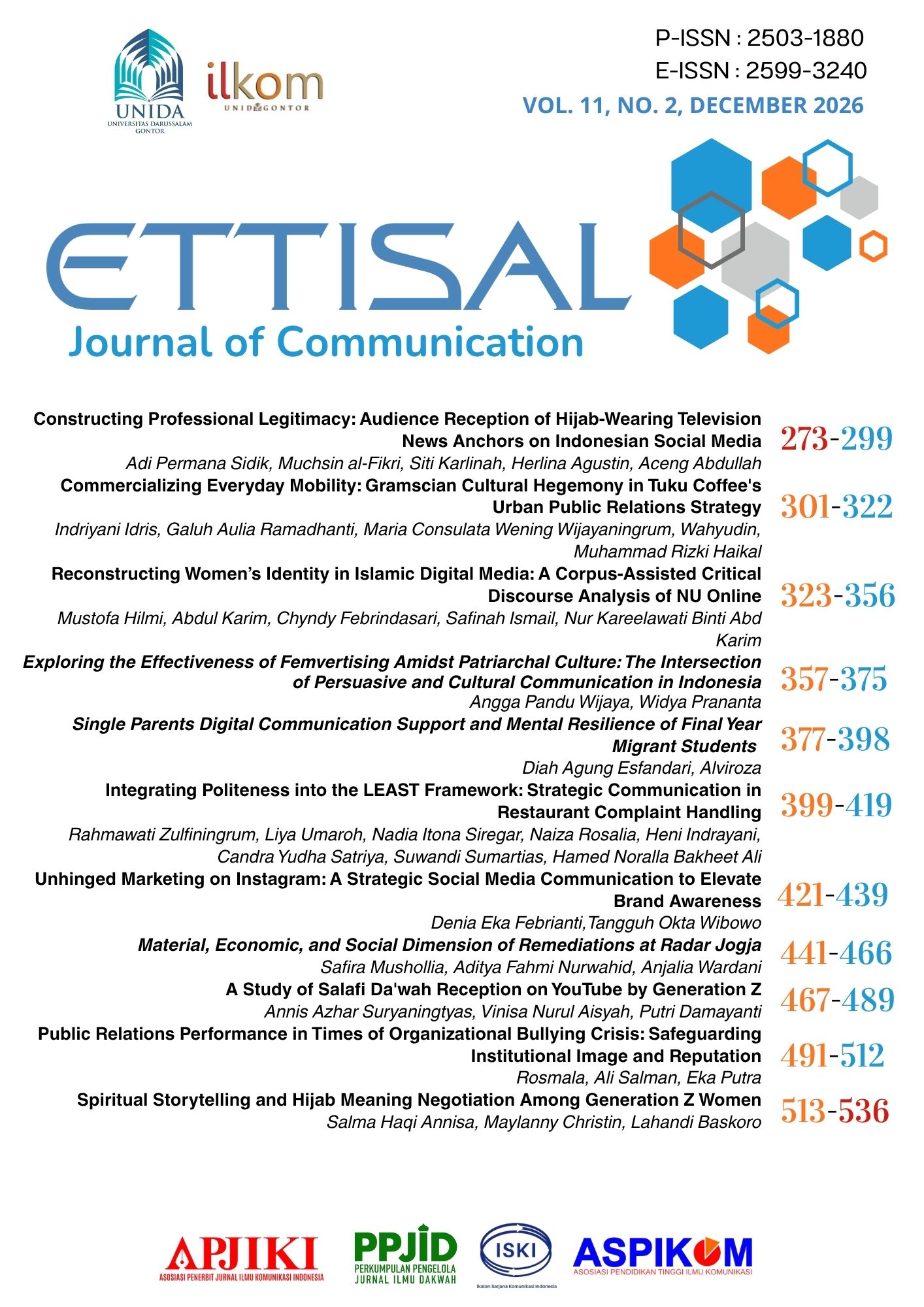
Reconstructing Women’s Identity in Islamic Digital Media: A Corpus-Assisted Critical Discourse Analysis of NU Online
DOI:
https://doi.org/10.21111/ettisal.v11i2.30Keywords:
Women’s Identity, Islamic Media, Critical Discourse Analysis, Corpus-Assisted Discourse Studies, NU Online, Gender RepresentationAbstract
As digital Islamic media expand, the representation of women within traditionalist religious discourses undergoes continuous negotiation. This study examines the construction of women’s identity in NU Online, the primary digital platform of Nahdlatul Ulama, Indonesia’s largest traditionalist Islamic organization. Combining Teun van Dijk’s Critical Discourse Analysis (CDA) with Corpus-Assisted Discourse Studies (CADS), the research employs a mixed-methods descriptive-analytical framework to evaluate a corpus of 157 articles containing the term perempuan (women), totaling 128,619 tokens. Using AntConc 4.2.4, collocates were analyzed within an L5–R5 window to identify discursive patterns, supported by concordance analysis to reveal contextual and ideological functions. The findings demonstrate that NU Online discursively frames women through affirmative and development-oriented categories, associating them with institutional protection, social movements, religious authority, leadership, rights, and struggle. However, qualitative concordance analysis reveals that female agency remains bounded by collective, moral, and institutional frameworks. At the social cognition level, these representations reflect NU’s institutional interpretative schemas—rooted in pesantren traditions and organizational authority—rather than individual authorship. The study concludes that while NU Online actively fosters discursive space for women's socio-religious participation, it simultaneously negotiates and demarcates the boundaries of female authority within traditional Islamic structures.
References
Aaldering, Loes, and Daphne Joanna Van Der Pas. 2020. “Political Leadership in the Media: Gender Bias in Leader Stereotypes during Campaign and Routine Times.” British Journal of Political Science 50 (3): 911–31. https://doi.org/10.1017/S0007123417000795.
Agbiboa, Daniel Egiegba. 2014. “Boko-Haram and the Global Jihad: ‘Do Not Think Jihad Is Over. Rather Jihad Has Just Begun.’” Australian Journal of International Affairs 68 (4): 400–417. https://doi.org/10.1080/10357718.2014.891564.
Akmaliah, Wahyudi. 2020. “The Demise of Moderate Islam: New Media, Contestation, and Reclaiming Religious Authorities.” Indonesian Journal of Islam and Muslim Societies 10 (1): 1–24. https://doi.org/10.18326/ijims.v10i1.1-24.
Avishai, Orit, Afshan Jafar, and Rachel Rinaldo. 2015. “A Gender Lens on Religion.” Gender & Society 29 (1): 5–25. https://doi.org/10.1177/0891243214548920.
Baker, Paul. 2012. “Acceptable Bias? Using Corpus Linguistics Methods with Critical Discourse Analysis.” Critical Discourse Studies 9 (3): 247–56. https://doi.org/10.1080/17405904.2012.688297.
Baker, Paul, Costas Gabrielatos, Majid KhosraviNik, Michał Krzyżanowski, Tony McEnery, and Ruth Wodak. 2008. “A Useful Methodological Synergy? Combining Critical Discourse Analysis and Corpus Linguistics to Examine Discourses of Refugees and Asylum Seekers in the UK Press.” Discourse & Society 19 (3): 273–306. https://doi.org/10.1177/0957926508088962.
Baker, Paul, Costas Gabrielatos, and Tony McEnery. 2013. Discourse Analysis and Media Attitudes. Cambridge University Press. https://doi.org/10.1017/CBO9780511920103.
Baker, Paul, and Tony McEnery. 2005. “A Corpus-Based Approach to Discourses of Refugees and Asylum Seekers in UN and Newspaper Texts.” Journal of Language and Politics 4 (2): 197–226. https://doi.org/10.1075/jlp.4.2.04bak.
Banet-Weiser, Sarah, Rosalind Gill, and Catherine Rottenberg. 2020. “Postfeminism, Popular Feminism and Neoliberal Feminism? Sarah Banet-Weiser, Rosalind Gill and Catherine Rottenberg in Conversation.” Feminist Theory 21 (1): 3–24. https://doi.org/10.1177/1464700119842555.
Batchelor, Jordan. 2024. “Getting into Bed with Embeddings? A Comparison of Collocations and Word Embeddings for Corpus-Assisted Discourse Analysis.” Applied Corpus Linguistics 4 (3): 100117. https://doi.org/10.1016/j.acorp.2024.100117.
Bednarek, Monika. 2008. “Semantic Preference and Semantic Prosody Re-Examined.” Corpus Linguistics and Linguistic Theory 4 (2). https://doi.org/10.1515/CLLT.2008.006.
Benwell, Bethan, and Elizabeth Stokoe. 2006. Discourse and Identity. Edinburgh University Press. https://doi.org/10.1515/9780748626533.
Biber, Douglas, Susan Conrad, and Randi Reppen. 1998. Corpus Linguistics. Cambridge University Press Google Schola. Vol. 2. Cambridge University Press. https://doi.org/10.1017/CBO9780511804489.
Bilge, Sirma. 2010. “Beyond Subordination vs. Resistance: An Intersectional Approach to the Agency of Veiled Muslim Women.” Journal of Intercultural Studies 31 (1): 9–28. https://doi.org/10.1080/07256860903477662.
Bös, Birte. 2019. “Monika Bednarek. 2018. Language and Television Series: A Linguistic Approach to TV Dialogue. The Cambridge Applied Linguistics Series. Cambridge: Cambridge University Press, Xv + 303 Pp., 40 Figures and 36 Tables, £ 28.99.” Anglia 137 (4): 660–65. https://doi.org/10.1515/ang-2019-0058.
Brezina, Vaclav. 2018. Statistics in Corpus Linguistics. Cambridge University Press. https://doi.org/10.1017/9781316410899.
Brezina, Vaclav, Tony McEnery, and Stephen Wattam. 2015. “Collocations in Context.” International Journal of Corpus Linguistics 20 (2): 139–73. https://doi.org/10.1075/ijcl.20.2.01bre.
Cameron, Deborah. 2014. “Gender and Language Ideologies.” In The Handbook of Language, Gender, and Sexuality, 279–96. Wiley. https://doi.org/10.1002/9781118584248.ch14.
Charrad, Mounira M. 2011. “Gender in the Middle East: Islam, State, Agency.” Annual Review of Sociology 37 (1): 417–37. https://doi.org/10.1146/annurev.soc.012809.102554.
Charteris-Black, Jonathan. 2018. Analysing Political Speeches: Rhetoric, Discourse and Metaphor. Bloomsbury Publishing. https://doi.org/https://doi.org/10.5040/9781350529601.
Dijk, Teun van. 2000. Ideology: A Multidisciplinary Approach. 1 Oliver’s Yard, 55 City Road, London EC1Y 1SP United Kingdom: SAGE Publications Ltd. https://doi.org/10.4135/9781446217856.
Duderija, Adis. 2017. “Tensions between the Study of Gender and Religion.” Hawwa 15 (3): 257–78. https://doi.org/10.1163/15692086-12341329.
Eagly, Alice H, and Steven J Karau. 2002. “Role Congruity Theory of Prejudice toward Female Leaders.” Psychological Review 109 (3): 573–98. https://doi.org/10.1037/0033-295X.109.3.573.
Fang, Yuhua. 2024. “Book Review: Mathew Gillings, Gerlinde Mautner and Paul Baker, Corpus-Assisted Discourse Studies.” Discourse Studies 26 (2): 281–83. https://doi.org/10.1177/14614456231216624.
Glas, Saskia, and Niels Spierings. 2019. “Support for Feminism among Highly Religious Muslim Citizens in the Arab Region.” European Journal of Politics and Gender 2 (2): 283–310. https://doi.org/10.1332/251510819X15538590890492.
Glas, Saskia, Niels Spierings, and Peer Scheepers. 2018. “Re-Understanding Religion and Support for Gender Equality in Arab Countries.” Gender & Society 32 (5): 686–712. https://doi.org/10.1177/0891243218783670.
Glick, Peter, and Susan T Fiske. 2001. “An Ambivalent Alliance: Hostile and Benevolent Sexism as Complementary Justifications for Gender Inequality.” American Psychologist 56 (2): 109–18. https://doi.org/10.1037/0003-066X.56.2.109.
Group, Pragglejaz. 2007. “MIP: A Method for Identifying Metaphorically Used Words in Discourse.” Metaphor and Symbol 22 (1): 1–39. https://doi.org/10.1080/10926480709336752.
Hamad, Ibnu. 2007. “Lebih Dekat Dengan Analisis Wacana.” Mediator: Jurnal Komunikasi 8 (2): 325–44. https://doi.org/10.29313/mediator.v8i2.1252.
Hannan, Nur, M. Syamsul Huda, Mohamad Anang Firdaus, Abdillah Afabih, and Yayan Musthofa. 2024. “Between Adherence to Madhhab and Adaptation to Context: Fatwās on Female Leadership in Nahdlatul Ulama-Affiliated Islamic Higher Education Institutions.” Journal of Islamic Law 5 (2): 269–87. https://doi.org/10.24260/JIL.V5I2.2725.
Hasyim, Nanang Mizwar. 2025. “THE DIALECTIC OF GENDER AND RELIGIOUS AUTHORITY: THE CONSTRUCTION OF DISCOURSE ON WOMEN IN NING IMAZ’S DIGITAL DA’WAH.” Al-Balagh : Jurnal Dakwah Dan Komunikasi 10 (2): 257–96. https://doi.org/10.22515/albalagh.v10i2.12493.
Hjarvard, Stig. 2011. “The Mediatisation of Religion: Theorising Religion, Media and Social Change.” Culture and Religion 12 (2): 119–35. https://doi.org/10.1080/14755610.2011.579719.
Hunston, Susan. 2007. “Semantic Prosody Revisited.” International Journal of Corpus Linguistics 12 (2): 249–68. https://doi.org/10.1075/ijcl.12.2.09hun.
Hunston, Susan, and John Sinclair. 2000. Evaluation in Text. Edited by Susan Hunston and Geoff Thompson. Evaluation in Text: Authorial Stance and the Construction of Discourse. Oxford University PressOxford. https://doi.org/10.1093/oso/9780198238546.001.0001.
Jaworska, Sylvia, and Anupam Nanda. 2016. “Doing Well by Talking Good: A Topic Modelling-Assisted Discourse Study of Corporate Social Responsibility.” Applied Linguistics 39 (3): amw014. https://doi.org/10.1093/applin/amw014.
Kandiyoti, Deniz. 1988. “Bargaining With Patriarchy.” Gender & Society 2 (3): 274–90. https://doi.org/10.1177/089124388002003004.
KhosraviNik, Majid. 2009. “The Representation of Refugees, Asylum Seekers and Immigrants in British Newspapers during the Balkan Conflict (1999) and the British General Election (2005).” Discourse & Society 20 (4): 477–98. https://doi.org/10.1177/0957926509104024.
Kloos, David. 2018. Becoming Better Muslims. Princeton University Press. https://doi.org/10.1515/9781400887835.
Lazar, Michelle M. 2007. “Feminist Critical Discourse Analysis: Articulating a Feminist Discourse Praxis.” Critical Discourse Studies 4 (2): 141–64. https://doi.org/https://doi.org/10.1080/17405900701464816.
———. 2017. “Feminist Critical Discourse Analysis.” In The Routledge Handbook of Critical Discourse Studies, 4:372–87. Routledge. https://doi.org/10.4324/9781315739342-26.
Leeuwen, Theo van. 2008. Discourse and Practice. Oxford University Press. https://doi.org/10.1093/acprof:oso/9780195323306.001.0001.
Lister, Ruth. 2003. Citizenship: Feminist Perspectives. Edited by Jo Campling. London: Macmillan Education UK. https://doi.org/10.1007/978-0-230-80253-7.
Litosseliti, Lia, and Jane Sunderland. 2002. Gender Identity and Discourse Analysis. Edited by Lia Litosseliti and Jane Sunderland. Vol. 2. Discourse Approaches to Politics, Society and Culture. Amsterdam: John Benjamins Publishing Company. https://doi.org/10.1075/dapsac.2.
Liu, Ming. 2024. “Towards a ‘Synergy’ of Text Mining and Critical Discourse Analysis: A Corpus-Assisted Discourse Study of Imagining China in Hong Kong Political Discourse.” Digital Scholarship in the Humanities 39 (2): 625–37. https://doi.org/10.1093/llc/fqae010.
Ma’rufah, Hafidhoh. 2023. “The Transformation of Religious Authority in The Era of New Media: Analyzing Disparities in Opportunities Between Female And Male Ulama in The Nahdlatul Ulama Online Media.” Jurnal Sosiologi Reflektif 18 (1): 63–88. https://doi.org/10.14421/JSR.V18I1.2956.
Mahmood, Saba. 2006. “Feminist Theory, Agency, and the Liberatory Subject: Some Reflections on the Islamic Revival in Egypt.” Temenos - Nordic Journal of Comparative Religion 42 (1). https://doi.org/10.33356/temenos.4633.
———. 2015. Religious Difference in a Secular Age. Princeton University Press. https://doi.org/10.2307/j.ctvc77k82.
Mautner, Gerlinde. 2016. “Checks and Balances: How Corpus Linguistics Can Contribute to CDA.” In Methods of Critical Discourse Studies. 1 Oliver’s Yard, 55 City Road London EC1Y 1SP United States: SAGE Publications Ltd. https://doi.org/10.4135/9781036235192.n7.
Mills, Sara. 2001. Language and Sexism. Cambridge University Press. https://doi.org/10.1017/CBO9780511755033.
Montgomery, Martin. 2007. The Discourse of Broadcast News. Routledge. https://doi.org/10.4324/9780203006634.
Mudhofi, M., and Abdul Karim. 2024a. “Transformation of New Media in Aswaja Al-Nahdliyyah Da’wah: Strategies and Challenges in the Contestation of Religious Authority in Indonesia.” Islamic Communication Journal 9 (1): 133–46. https://doi.org/10.21580/icj.2024.9.1.22071.
Mudhofi, M, and Abdul Karim. 2024b. “Transformation of New Media in Aswaja Al-Nahdliyyah Da’wah: Strategies and Challenges in the Contestation of Religious Authority in Indonesia.” Islamic Communication Journal 9 (1): 133–46. https://doi.org/https://doi.org/10.21580/icj.2024.9.1.22071.
Mun’im, Zainul, Muhamad Nasrudin, Suaidi, and Hasanudin. 2024. “Revisioning Official Islam in Indonesia: The Role of Women Ulama Congress in Reproducing Female Authority in Islamic Law.” Ahkam: Jurnal Ilmu Syariah 24 (1): 135–52. https://doi.org/10.15408/AJIS.V24I1.34744.
Nisa, Eva F., and Farid F. Saenong. 2022. “Relegitimizing Religious Authority: Indonesian Gender-Just ʿUlamāʾ Amid COVID-19.” Religions 13 (6): 485. https://doi.org/10.3390/rel13060485.
Nisa, Eva F. 2018. “Creative and Lucrative Daʿwa: The Visual Culture of Instagram amongst Female Muslim Youth in Indonesia.” Asiascape: Digital Asia 5 (1–2): 68–99. https://doi.org/10.1163/22142312-12340085.
———. 2019. “Muslim Women in Contemporary Indonesia: Online Conflicting Narratives behind the Women Ulama Congress.” Asian Studies Review 43 (3): 434–54. https://doi.org/10.1080/10357823.2019.1632796.
Öztürk, Cemal. 2022. “Revisiting the Islam-Patriarchy Nexus: Is Religious Fundamentalism the Central Cultural Barrier to Gender Equality?” Zeitschrift Für Religion, Gesellschaft Und Politik 7 (1): 173–206. https://doi.org/10.1007/s41682-022-00130-3.
Partington, Alan, Alison Duguid, and Charlotte Taylor. 2013. Patterns and Meanings in Discourse. Vol. 55. Studies in Corpus Linguistics. Amsterdam: John Benjamins Publishing Company. https://doi.org/10.1075/scl.55.
Poole, Elizabeth. 2002. Reporting Islam. I.B. Tauris. https://doi.org/10.5040/9780755604579.
Raya, Moch Khafidz Fuad. 2025. “Digital Islam: New Space for Authority and Religious Commodification among Islamic Preachers in Contemporary Indonesia.” Contemporary Islam 19 (1): 161–94. https://doi.org/10.1007/s11562-024-00570-z.
Rayson, Paul. 2008. “From Key Words to Key Semantic Domains.” International Journal of Corpus Linguistics 13 (4): 519–49. https://doi.org/10.1075/ijcl.13.4.06ray.
Reisigl, Martin, and Ruth Wodak. 2005. Discourse and Discrimination. Routledge. https://doi.org/10.4324/9780203993712.
Rinaldo, Rachel. 2013. “Islam and Feminism in Jakarta.” In Mobilizing Piety, 1–31. Oxford University Press. https://doi.org/10.1093/acprof:oso/9780199948109.003.0001.
Schröter, Melani. 2018. Exploring Silence and Absence in Discourse. Edited by Melani Schröter and Charlotte Taylor. Kritiska Text-Och Diskursstudier. Vol. 37. Cham: Springer International Publishing. https://doi.org/10.1007/978-3-319-64580-3.
Scott, Mike. 1997. “PC Analysis of Key Words — And Key Key Words.” System 25 (2): 233–45. https://doi.org/10.1016/S0346-251X(97)00011-0.
Sinclair, John. 2004. Trust the Text. Edited by Ronald Carter. Routledge. https://doi.org/10.4324/9780203594070.
Stokoe, Elizabeth. 2012. “Moving Forward with Membership Categorization Analysis: Methods for Systematic Analysis.” Discourse Studies 14 (3): 277–303. https://doi.org/10.1177/1461445612441534.
Stubbs, Michael. 2001. “On Inference Theories and Code Theories: Corpus Evidence for Semantic Schemas.” Text - Interdisciplinary Journal for the Study of Discourse 21 (3): 437–65. https://doi.org/10.1515/text.2001.007.
Tsuria, Ruth. 2020. “Religion, Gender, and Digital Media.” In The International Encyclopedia of Gender, Media, and Communication, 12:1–5. Wiley. https://doi.org/10.1002/9781119429128.iegmc033.
Uyuni, Badrah, Mohammad Adnan, Abdul Hadi, Muallimah Rodhiyana, and Sarbini Anim. 2025. “Virtual Spaces of Islamic Preaching: Digital Majelis Taklim and the Changing Role of Women in Indonesia.” Nature Anthropology 3 (2): 10005–10005. https://doi.org/10.70322/natanthropol.2025.10005.
Weatherall, Ann. 2005. Gender, Language and Discourse. Routledge. https://doi.org/10.4324/9780203988817.
Wodak, Ruth, and Michael Meyer. 2001. Methods of Critical Discourse Analysis. 6 Bonhill Street, London EC2A 4PU: SAGE Publications, Ltd. https://doi.org/10.4135/9780857028020.
Wulff, Stefanie, and Paul Baker. 2020. “Analyzing Concordances.” In A Practical Handbook of Corpus Linguistics, 161–79. Cham: Springer International Publishing. https://doi.org/10.1007/978-3-030-46216-1_8.
Yuval‐Davis, Nira. 1993. “Gender and Nation.” Ethnic and Racial Studies 16 (4): 621–32. https://doi.org/10.1080/01419870.1993.9993800.
Submitted
Accepted
Published
Issue
Section
License
Copyright (c) 2026 Mustofa Hilmi, Abdul Karim, Chyndy Febrindasari, Safinah Ismail, Nur Kareelawati Binti Abd Karim

This work is licensed under a Creative Commons Attribution-NonCommercial-ShareAlike 4.0 International License.
Ettisal: Journal of Communication is committed to the principle that making research freely available to the public supports a greater global exchange of knowledge.
All articles published in Ettisal are open access and freely available online immediately upon publication, without any subscription or access fees. Readers are allowed to read, download, copy, distribute, print, search, or link to the full texts of the articles, or use them for any other lawful purpose, without asking prior permission from the publisher or the author, provided that the use is non-commercial and the original source is properly cited.
All works published in Ettisal: Journal of Communication are licensed under the Creative Commons Attribution–NonCommercial–ShareAlike 4.0 International License (CC BY-NC-SA 4.0).
This means:
-
Users may share (copy and redistribute) and adapt (remix, transform, and build upon) the material in any medium or format for non-commercial purposes.
-
Appropriate credit must be given to the author(s) and the journal, a link to the license must be provided, and any derivative works must be distributed under the same license.
-
Commercial use of the published material is not permitted without prior written consent from the author(s) and the journal.
Authors retain full copyright to their work and grant Ettisal: Journal of Communication the right of first publication. Authors may also deposit their published articles in institutional repositories or personal websites, acknowledging the journal as the original place of publication.
Through this open access policy, Ettisal: Journal of Communication aims to promote ethical scholarship, knowledge dissemination, and public engagement with communication studies worldwide.