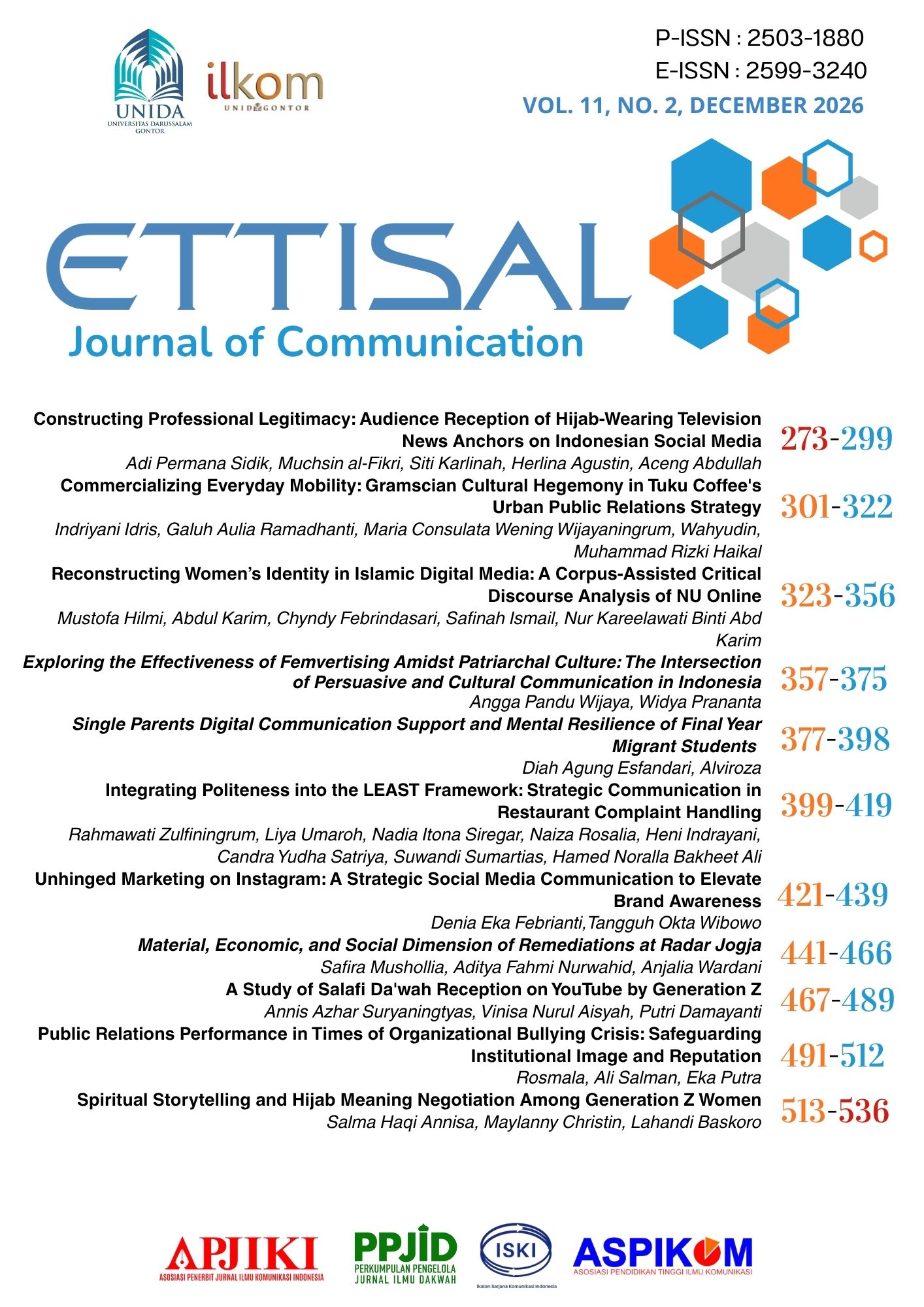
Integrating Politeness into the LEAST Framework: Strategic Communication in Restaurant Complaint Handling
DOI:
https://doi.org/10.21111/ettisal.v11i2.36Keywords:
Company Culture, Customer Complaint Handling, LEAST, Politeness Principles, Quick Service RestaurantAbstract
In Indonesia’s fast-food industry, effective complaint handling serves as a vital strategic communication tool to mitigate reputation damage and sustain customer retention. While quick-service restaurants (QSRs) often rely on operational frameworks such as LEAST (Listen, Empathize, Apologize, Solve, Thank) for service recovery, the communicative quality and politeness strategies embedding these procedures remain underexplored. This qualitative descriptive study examines how QSRs integrate linguistic politeness strategies and corporate culture into the LEAST framework. Data were collected through in-depth interviews with corporate leadership, HR, marketing, shift captains, and front-line crew, supplemented by field observations and document analysis. The findings reveal that while the Solve stage operates as the primary operational focus through immediate compensation and structured escalation, emotional de-escalation relies heavily on the Listen, Empathize, and Apologize stages through tactful speech, controlled tone, and linguistic humility. These practices directly align with key politeness maxims (tact, generosity, approbation, and modesty) and are sustained through case-based briefings, SOP training, and complaint audits. The study demonstrates that procedural frameworks like LEAST succeed in QSR environments only when coupled with culturally embedded politeness strategies, offering a holistic model for strategic customer communication.
References
Abdi, F. A., Rahmadani, N., Harahap, F. S., Siregar, U. K., & Nasution, A. O. (2025). Analysis of the Level of Customer Satisfaction with the Quality of Food and Service of Get Steak Restaurants in Medan City. Algebra : Jurnal Pendidikan, Sosial Dan Sains, 5(2), 89–95. https://doi.org/10.58432/ALGEBRA.V5I2.1323
Agnihotri, D., Kulshreshtha, K., Tripathi, V., & Chaturvedi, P. (2022). “Actions speak louder than words”: an impact of service recovery antecedents on customer delight in quick-service restaurants. Asia-Pacific Journal of Business Administration, 14(4), 421–444. https://doi.org/10.1108/APJBA-04-2021-0133
Anshori, M. Y., Rasyid, R. A., & Herlambang, T. (2025). How Transformational Leadership, Corporate Culture, and Intrinsic Motivation Shape Hospitality Employee Performance? Jurnal Manajemen Teori Dan Terapan| Journal of Theoretical and Applied Management, 18(2), 258–274. https://doi.org/10.20473/jmtt.v18i2.72024
Aulia, M., Fitriana, R., & Shabrina, A. (2025). Emotional Branding in Joongla : A Marketing Communication in Indonesian Gastronomic Restaurant Emotional Branding pada Joongla : Strategi Komunikasi Pemasaran di Restoran Gastronomi Indonesia. 10(1).
Christou, P. A. (2023). How to use thematic analysis in qualitative research. Journal of Qualitative Research in Tourism, 3(2), 79–95. https://doi.org/10.4337/jqrt.2023.0006
Creswell, J. W. (2018). Research Design Qualitative, Quantitative, and Mixed Methods Approaches Fifth Edition. SAGE Publications Inc.
Donohue, W. A., & Druckman, D. (2025). Face threats in conflict escalation: politeness theory versus social interactionist theory. International Journal of Conflict Management, 36(4), 699–717. https://doi.org/10.1108/IJCMA-10-2024-0280
Ghlichlee, B., & Bayat, F. (2021). Frontline employees’ engagement and business performance: the mediating role of customer-oriented behaviors. Management Research Review, 44(2), 290–317. https://doi.org/10.1108/MRR-11-2019-0482
Graham, J. R., Grennan, J., Harvey, C. R., & Rajgopal, S. (2022). Corporate culture: Evidence from the field. Journal of Financial Economics, 146(2), 552–593. https://doi.org/10.1016/j.jfineco.2022.07.008
Honora, A., Chih, W. H., & Ortiz, J. (2023). What drives customer engagement after a service failure? The moderating role of customer trust. International Journal of Consumer Studies, 47(5), 1714–1732. https://doi.org/10.1111/ijcs.12939
Istanbulluoglu, D., & Sakman, E. (2024). Successful complaint handling on social media predicts increased repurchase intention: The roles of trust in company and propensity to trust. European Management Journal, 42(1), 11–22. https://doi.org/10.1016/j.emj.2022.06.004
Ivana, N. D. (2024, March 5). Buka Outlet ke-17 di Semarang, Oti Fried Chicken Usung Konsep Instagramable - Suara Merdeka. https://www.suaramerdeka.com/gaya-hidup/0412094337/buka-outlet-ke-17-di-semarang-oti-fried-chicken-usung-konsep-instagramable#google_vignette
Jewad, H. G., Ghapanchi, Z., & Ghazanfari, M. (2020). Investigating Leech’s Politeness Principle in Conversational Verses in Three Surahs from The Holy Quran. Asian Social Science, 16(3), 29. https://doi.org/10.5539/ass.v16n3p29
Kumolu-Johnson, B. (2024). Improving Service Quality in the Fast-Food Service Industry. Journal of Service Science and Management, 17(01), 55–74. https://doi.org/10.4236/JSSM.2024.171002
Leech, G. N. , 1936-, author. (1993). Prinsip-prinsip pragmatik. https://lib.ui.ac.id
Liao, H. (2007). Do it right this time: The role of employee service recovery performance in customer-perceived justice and customer loyalty after service failures. Journal of Applied Psychology, 92(2), 475–489. https://doi.org/10.1037/0021-9010.92.2.475
Loo, P. T., Khoo-Lattimore, C., & Boo, H. C. (2021). How should I respond to a complaining customer? A model of Cognitive-Emotive-Behavioral from the perspective of restaurant service employees. International Journal of Hospitality Management, 95, 102882. https://doi.org/10.1016/J.IJHM.2021.102882
Mathe-Soulek, K., Slevitch, L., & Dallinger, I. (2015). Applying mixed methods to identify what drives quick service restaurant’s customer satisfaction at the unit-level. International Journal of Hospitality Management, 50, 46–54. https://doi.org/10.1016/J.IJHM.2015.07.007
Mendocilla, M., Miravitlles, P., & Matute, J. (2021). QUICKSERV : a service quality assessment tool for the quick-service restaurant industry. 123(13), 241–259. https://doi.org/10.1108/BFJ-12-2020-1108
Metz, D., Ilieş, L., & Nistor, R. L. (2020). The Impact of Organizational Culture on Customer Service Effectiveness from a Sustainability Perspective. Sustainability, 12(15). https://doi.org/10.3390/SU12156240
Min, K. S., Jung, J. M., & Ryu, K. (2021). Listen to their heart: Why does active listening enhance customer satisfaction after a service failure? International Journal of Hospitality Management, 96, 102956. https://doi.org/10.1016/J.IJHM.2021.102956
Namin, A. (2017). Revisiting customers’ perception of service quality in fast food restaurants. Journal of Retailing and Consumer Services, 34, 70–81. https://doi.org/10.1016/J.JRETCONSER.2016.09.008
Ojukwu, C. K., & Dike, C. J. (2023). Politeness strategies and face-threatening acts in master-servant relationships in selected Wole Soyinka and William Shakespeare’s drama texts. IKENGA International Journal of Institute of African Studies, 24(1), 1–19. https://doi.org/10.53836/IJIA/2023/24/1/008
OTI Fried Chicken - OTI Fried Chicken. (n.d.). Retrieved July 1, 2026, from https://otifriedchicken.com/
Putri, H. J., & Sri, Murhayati. (2025). Metode Pengumpulan Data Kualitatif. Jurnal Pendidikan Tambusai, 11(1), 13074–13086.
Radianto, E. (2023). Interpretasi Modern tentang Teori dan Filosofis Penelitian. XXXII(1), 56–74.
Shahril, Z., Zulkafly, H. A., Ismail, N. S., & Sharif, N. U. N. M. (2021). Customer Satisfaction Towards Self-Service Kiosks for Quick Service Restaurants (QSRs) in Klang Valley. International Journal of Academic Research in Business and Social Sciences, 11(13). https://doi.org/10.6007/ijarbss/v11-i13/8502
Singh, G., Slack, N., Sharma, S., Mudaliar, K., Narayan, S., Kaur, R., & Sharma, K. U. (2021). Antecedents involved in developing fast-food restaurant customer loyalty. The TQM Journal, 33(8), 1753–1769. https://doi.org/10.1108/TQM-07-2020-0163
Siswanto, S., Afriadi, D., Fauzi, R. A., & Adawiyah, R. (2025). Principles of Polite Language Use for Grade XI Students at SMK Kelapa Sawit Arsya Geneeta Indonesia Pangkalan Kerinci. J-LELC: Journal of Language Education, Linguistics, and Culture, 5(1), 72–77. https://doi.org/10.25299/j-lelc.2025.22570
Sulastri, S., & Hengky, S. (2025). Front Office Communication Management in Handling Guest Complaints at Three-Star Hotels in Bogor. Finance : International Journal of Management Finance, 2(3), 74–84. https://doi.org/10.62017/finance.v2i3.128
Sypniewska, B., Baran, M., & Kłos, M. (2023). Work engagement and employee satisfaction in the practice of sustainable human resource management – based on the study of Polish employees. International Entrepreneurship and Management Journal, 19(3), 1–32. https://doi.org/10.1007/s11365-023-00834-9
Tasyarasita, A. Z., Djatmika, & Yulianti, W. (2025). Polite Disagreement: How Sellers Manage Conflict in Social Media Sales. Studies in Media and Communication, 13(1), 241–254. https://doi.org/10.11114/smc.v13i1.7239
van Mulken, M., & Heslenfled, L. (2025). Improving Complaint Handling: The Rhetorical Turn in Defensive and Accommodative Strategies. Business and Professional Communication Quarterly. https://doi.org/10.1177/23294906241308523
Wirakanda, G. G., & Putri, I. S. (2020). Analisis Penanganan Keluhan Pelanggan (Studi Kasus Di Kantor Pos Bandung 40000). Jurnal Bisnis Dan Pemasaran, 10(2), 1–11. https://ejurnal.poltekpos.ac.id/index.php/promark/article/view/1020/698
You, Y., Yang, X., Wang, L., & Deng, X. (2020). When and Why Saying “Thank You” Is Better Than Saying “Sorry” in Redressing Service Failures: The Role of Self-Esteem. Journal of Marketing, 84(2), 133–150. https://doi.org/10.1177/0022242919889894
Submitted
Accepted
Published
Issue
Section
License
Copyright (c) 2026 Rahmawati Zulfiningrum, Liya Umaroh, Nadia Itona Siregar, Naiza Rosalia, Heni Indrayani, Candra Yudha Satriya, Suwandi Sumartias, Hamed Noralla Bakheet Ali

This work is licensed under a Creative Commons Attribution-NonCommercial-ShareAlike 4.0 International License.
Ettisal: Journal of Communication is committed to the principle that making research freely available to the public supports a greater global exchange of knowledge.
All articles published in Ettisal are open access and freely available online immediately upon publication, without any subscription or access fees. Readers are allowed to read, download, copy, distribute, print, search, or link to the full texts of the articles, or use them for any other lawful purpose, without asking prior permission from the publisher or the author, provided that the use is non-commercial and the original source is properly cited.
All works published in Ettisal: Journal of Communication are licensed under the Creative Commons Attribution–NonCommercial–ShareAlike 4.0 International License (CC BY-NC-SA 4.0).
This means:
-
Users may share (copy and redistribute) and adapt (remix, transform, and build upon) the material in any medium or format for non-commercial purposes.
-
Appropriate credit must be given to the author(s) and the journal, a link to the license must be provided, and any derivative works must be distributed under the same license.
-
Commercial use of the published material is not permitted without prior written consent from the author(s) and the journal.
Authors retain full copyright to their work and grant Ettisal: Journal of Communication the right of first publication. Authors may also deposit their published articles in institutional repositories or personal websites, acknowledging the journal as the original place of publication.
Through this open access policy, Ettisal: Journal of Communication aims to promote ethical scholarship, knowledge dissemination, and public engagement with communication studies worldwide.