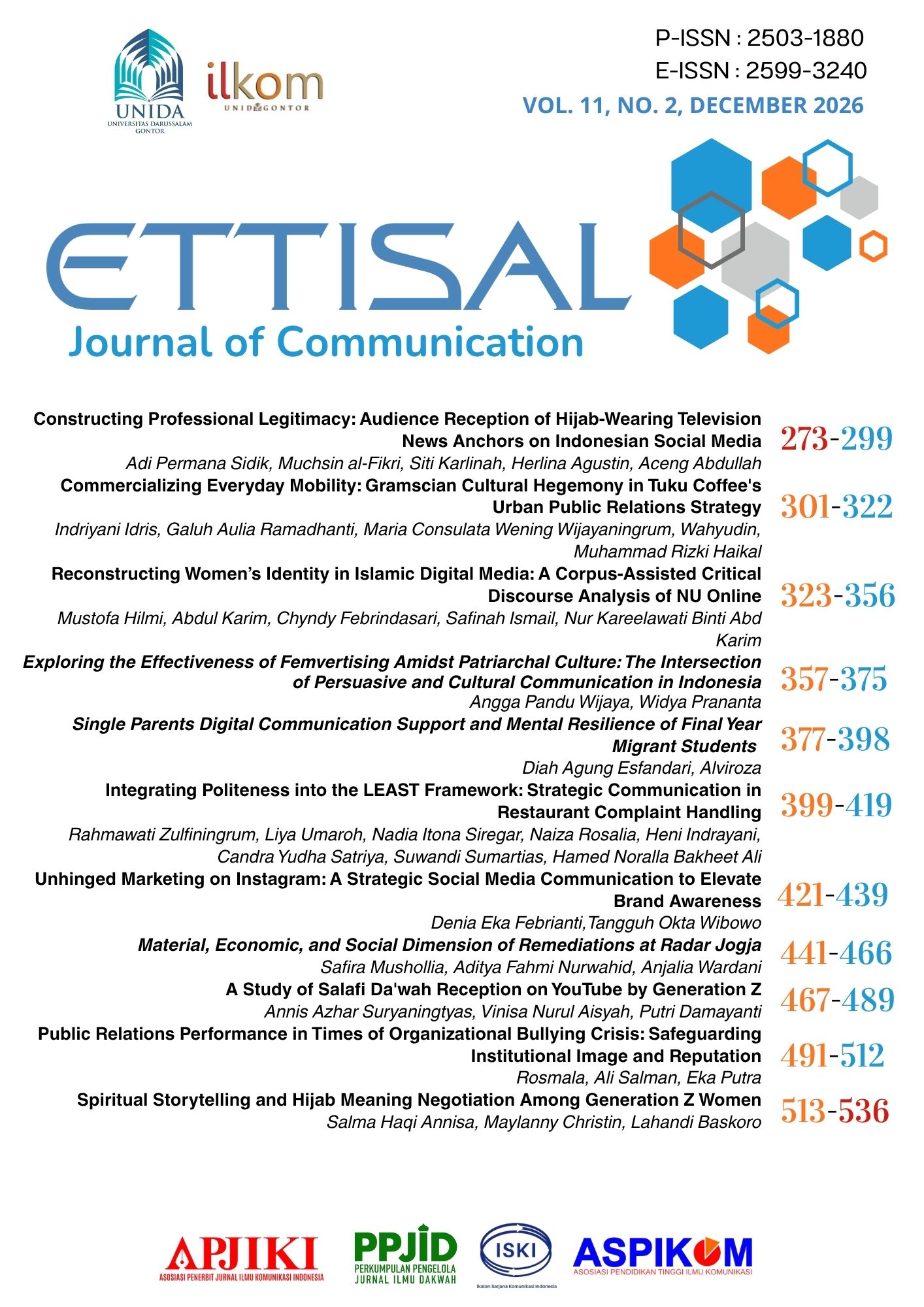
Constructing Professional Legitimacy: Audience Reception of Hijab-Wearing Television News Anchors on Indonesian Social Media
DOI:
https://doi.org/10.21111/ettisal.v11i2.4Keywords:
Hijab-Wearing Television News Anchors, Professional Legitimacy, Audience Reception Theory, Digital Journalism, Social Construction of Reality, Social Media InteractionAbstract
Television news anchors occupy highly visible professional positions in which journalistic identity intersects with personal and social representation. For Muslim women who wear the hijab, visible religious identity may become an important element through which audiences interpret their public and professional image. Although previous studies have examined Muslim women journalists in relation to representation, gender, and newsroom practices, less attention has been given to how digital audiences negotiate the professional legitimacy of hijab-wearing television news anchors through social media interactions. This study examines how audiences interpret and negotiate the professional legitimacy of three Indonesian television news anchors—Yaumi Fitri, Eva Yunizar, and Rahma Hayuningdyah—through comments on Instagram and YouTube. Employing a qualitative digital reception analysis, the study analyzes 169 publicly available audience comments associated with 24 social media posts collected in 2024. The comments were manually coded and analyzed thematically, drawing on Stuart Hall’s encoding/decoding framework and Berger and Luckmann’s Social Construction of Reality. The findings reveal three interrelated patterns. First, audiences express religious appreciation, personal admiration, and recognition of the anchors’ visible religious identity, although their responses are not entirely uniform. Second, audience interpretations involve both dominant-hegemonic and negotiated readings, particularly concerning religious commitment, expectations of consistency, and visual appearance, while clear oppositional readings are limited in the selected data. Third, digital audience participation provides a space in which the compatibility between visible religious identity and professional journalism is socially recognized and negotiated. This study contributes to audience reception research by demonstrating how digital interactions participate in the social negotiation of professional identity, while distinguishing public recognition from formal institutional legitimacy and demonstrated journalistic competence.
References
Ahmed, S., & Matthes, J. (2017). Media representation of Muslims and Islam from 2000 to 2015: A meta-analysis. International Communication Gazette, 79(3). https://doi.org/10.1177/1748048516656305
Atad, E., & Cohen, J. (2024). Look me in the eyes: How direct address affects viewers’ experience of parasocial interaction and credibility? Journalism, 25(4). https://doi.org/10.1177/14648849231169886
Berger, L. P., & Luckman, T. (2013). Tafsir Sosial Atas Kenyataan (10th ed.). LP3ES.
Bødker, H. (2016). Stuart Hall’s encoding/decoding model and the circulation of journalism in the digital landscape. Critical Studies in Media Communication, 33(5). https://doi.org/10.1080/15295036.2016.1227862
Bowe, B. J., Gosen, J., & Fahmy, S. (2019). Personal Choice or Political Provocation: Examining the Visual Framing and Stereotyping of the Burkini Debate. Journalism and Mass Communication Quarterly, 96(4). https://doi.org/10.1177/1077699019826093
Braun, V., & Clarke, V. (2021). One size fits all? What counts as quality practice in (reflexive) thematic analysis? Qualitative Research in Psychology, 18(3). https://doi.org/10.1080/14780887.2020.1769238
Bungin, B. (2011). Konstruksi Sosial Media Massa. Kencana Prenada Media.
Connolly-Ahern, C., Ahern, L., Coman, I. A., Molina Davila, M. D., Davis, S. E., & Cabrera-Baukus, M. (2019). The Cost of the Veil: Visual Communication Impacts of Hijab on News Judgments. Mass Communication and Society, 22(6). https://doi.org/10.1080/15205436.2019.1685107
Couldry, N., & Hepp, A. (2020). Media and the social construction of reality. In The Oxford Handbook of Digital Media Sociology. https://doi.org/10.1093/oxfordhb/9780197510636.013.2
Finneman, T., Thomas, R. J., & Jenkins, J. (2019). “I Always Watched Eyewitness News Just to See Your Beautiful Smile”: Ethical Implications of U.S. Women TV Anchors’ Personal Branding on Social Media. Journal of Media Ethics: Exploring Questions of Media Morality, 34(3), 146–159. https://doi.org/10.1080/23736992.2019.1638260
Guo, M., & Sun, F. S. (2023). Local Television News on Instagram: Exploring the Effects of News Values and Post Features on Audience Engagement. JMM International Journal on Media Management, 25(1–2). https://doi.org/10.1080/14241277.2023.2204528
Hall, S. (1973). 10 Encoding / decoding *. Encoding and Decoding in Television Discourse, 7.
Hamad, I. (2004). Konstruksi Realitas Politik dalam Media Massa. Granit.
Haq, N. (2025). ‘The national media just sees Muslims as if they are not people like us’: The alternate social imaginaries of local journalists reporting on Muslims. Media, Culture and Society, 47(4). https://doi.org/10.1177/01634437241313042
Hawkins, I., Coles, S. M., Saleem, M., Moorman, J. D., & Aqel, H. (2024). How Reel Middle Easterners’ Portrayals Cultivate Stereotypical Beliefs and Policy Support. Mass Communication and Society, 27(1). https://doi.org/10.1080/15205436.2022.2062000
Hendrickx, J. (2023). Power to the People? Conceptualising Audience Agency for the Digital Journalism Era. In Digital Journalism (Vol. 11, Issue 7). https://doi.org/10.1080/21670811.2022.2084432
Ibrahim, O., & Fahmy, S. (2025). Unveiling the Veil: Examining the Stereotyping of Hijab in Internet Memes and GIFs. International Journal of Communication, 19.
Levy-Landesberg, H., & Cao, X. (2025). Anchoring voices: The news anchor’s voice in China from television to AI. Media, Culture and Society, 47(2). https://doi.org/10.1177/01634437241270937
Luginbühl, M. (2025). TV news on Instagram: Affordances, genres, journalistic cultures. Discourse and Communication, 19(1). https://doi.org/10.1177/17504813241270395
Mellado, C., & Hermida, A. (2021). The Promoter, Celebrity, and Joker Roles in Journalists’ Social Media Performance. Social Media and Society, 7(1). https://doi.org/10.1177/2056305121990643
Molyneux, L., & McGregor, S. C. (2022). Legitimating a platform: evidence of journalists’ role in transferring authority to Twitter. Information Communication and Society, 25(11). https://doi.org/10.1080/1369118X.2021.1874037
Ni’mah, Z. (2021). The Political Meaning of the Hijab Style of Women Candidates. Journal of Current Southeast Asian Affairs, 40(1). https://doi.org/10.1177/1868103421989071
Pahwa, S. (2021). Styling strength. Pious fashion and fitness on surviving hijab. Journal of Middle East Women’s Studies, 17(1). https://doi.org/10.1215/15525864-8790252
Tsai, H. Y. S., & Lin, H. F. (2023). Social TV and audience engagement: investigating the relationship between Facebook engagement and TV performance of The Voice (USA). Online Information Review, 47(3). https://doi.org/10.1108/OIR-06-2021-0293
Wigger, I. (2019). Anti-Muslim racism and the racialisation of sexual violence: ‘intersectional stereotyping’ in mass media representations of male Muslim migrants in Germany. Culture and Religion, 20(3). https://doi.org/10.1080/14755610.2019.1658609
Submitted
Accepted
Published
Issue
Section
License
Copyright (c) 2026 Adi Permana Sidik, Muchsin al-Fikri, Siti Karlinah, Herlina Agustin, Aceng Abdullah

This work is licensed under a Creative Commons Attribution-NonCommercial-ShareAlike 4.0 International License.
Ettisal: Journal of Communication is committed to the principle that making research freely available to the public supports a greater global exchange of knowledge.
All articles published in Ettisal are open access and freely available online immediately upon publication, without any subscription or access fees. Readers are allowed to read, download, copy, distribute, print, search, or link to the full texts of the articles, or use them for any other lawful purpose, without asking prior permission from the publisher or the author, provided that the use is non-commercial and the original source is properly cited.
All works published in Ettisal: Journal of Communication are licensed under the Creative Commons Attribution–NonCommercial–ShareAlike 4.0 International License (CC BY-NC-SA 4.0).
This means:
-
Users may share (copy and redistribute) and adapt (remix, transform, and build upon) the material in any medium or format for non-commercial purposes.
-
Appropriate credit must be given to the author(s) and the journal, a link to the license must be provided, and any derivative works must be distributed under the same license.
-
Commercial use of the published material is not permitted without prior written consent from the author(s) and the journal.
Authors retain full copyright to their work and grant Ettisal: Journal of Communication the right of first publication. Authors may also deposit their published articles in institutional repositories or personal websites, acknowledging the journal as the original place of publication.
Through this open access policy, Ettisal: Journal of Communication aims to promote ethical scholarship, knowledge dissemination, and public engagement with communication studies worldwide.