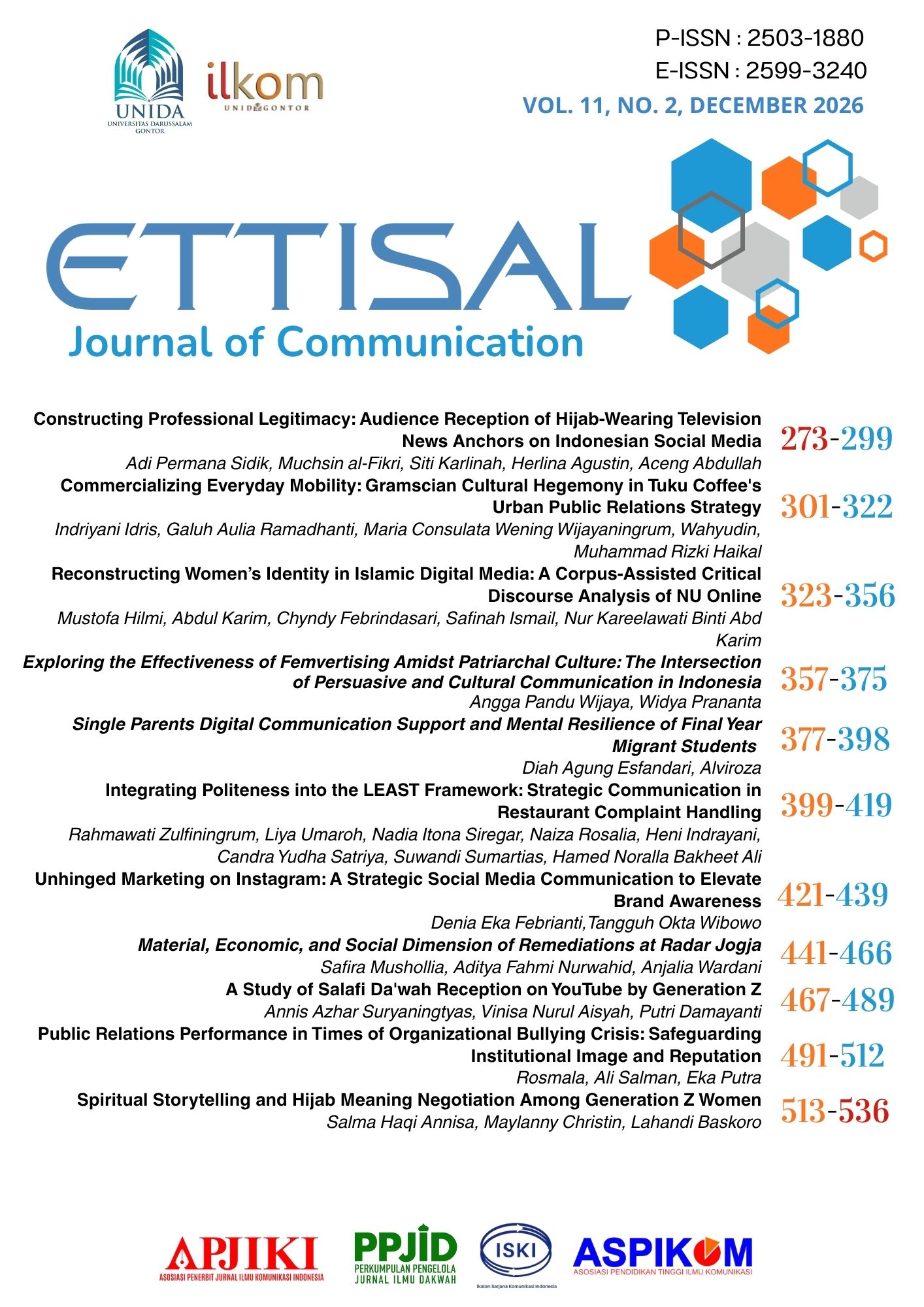
Material, Economic, and Social Dimension of Remediations at Radar Jogja
DOI:
https://doi.org/10.21111/ettisal.v11i2.63Keywords:
Remediation, Digital Transformation, Platform LogicAbstract
This study investigates the digital transformation of local print media through the remediation process at Radar Jogja, a regional newspaper in Yogyakarta adapting to the digital ecosystem. Motivated by declining print circulation and a shift in public consumption toward online platforms, the research identifies Radar's forms of remediation and analyzes their dynamics across material, economic, and social dimensions. Using a qualitative case study approach, the study collected data through semi-structured interviews with key editorial and digital personnel, direct observation, and document analysis, then analyzed it using pattern-matching techniques. The results indicate that, in the material dimension, Radar Jogja demonstrates both light and heavy remediation, ranging from simple link-sharing on text-based platforms to extensive audiovisual adaptation on Instagram and TikTok, primarily influenced by platform logic and organizational sub-branding through Radar Malioboro. In the economic dimension, although the outlet has adopted digital attention-economy metrics, it remains structurally dependent on print revenue and uses digital publishing partly to address print space limitations. In the social dimension, Radar Jogja continues its traditional public policy watchdog role across digital formats, while also accommodating commercial imperatives such as sponsored segments. The study concludes that remediation in local media is a multi-dimensional, non-linear process shaped by the ongoing interaction among journalistic identity, platform algorithms, and economic constraints, offering key theoretical and practical insights into the survival of legacy media in the digital era.
References
Bolter, J. D., & Grusin Richard. (1999). Remediation: Understanding New Media (xi, 295). Cambridge, Massachusetts: MIT Press.
Bahana. (2026, September 6-7 and 11) Personal Interview
Bukan Kucing Biasa, Ukuran Raksasa bikin Penasaran. (2026, September 27). Radar Jogja.
Creswell, J. W. (2014). Research Design: Qualitative, Quantitative, and Mixed Methods Approaches (4th ed.). Thousand Oaks, California: SAGE Publications.
Denzin, N. K. (2017). The Research Act: A Theoretical Introduction to Sociological Methods (3rd ed.). New York: Routledge.
Erniwati, Alimuddin Unde, A., Cangara, H., & Hidayatullah, F. (2023). New Media Disruption Towards Mainstream Media Resistance (Study of Fajar and Tribun Timur Daily in Makassar City). Jurnal Dakwah Dan Komunikasi, 17(1), 2548–9496. https://doi.org/10.24090.komunika.v15i2.7542
Fahriza, Fahmi. (2026, September 13). Personal Interview.
Harcup, T., & O’Neill, D. (2017). What is News?: News values revisited (again). Journalism Studies, 18(12), 1470–1488. https://doi.org/10.1080/1461670X.2016.1150193
Jakpat. (2025, July 24). Indonesia Mobile Entertainment & Social Media Trends – 1st Semester of 2025. Retrieved August 31, 2026, from Jakpat website: Indonesia Mobile Entertainment & Social Media Trends – 1st Semester of 2025
Jenkins, H. (2006). Convergence Culture: Where Old and New Media Collide. New York: New York University Press.
Karunianingsih, D. A. (2021). Konvergensi Media pada Podcast Radar Jogja Digital dalam Publikasi Berita dan Perluasan Segmentasi Audiens. Jurnal Studi Komunikasi Dan Media.
Kemp, S. (2025, October 15). Digital 2026 Global Overview Report. Retrieved August 31, 2026, from We Are Social website: Digital 2026 Global Overview Report
Keracunan MBG, Warga Tagih sikap DPRD. (2026, September 25). Radar Jogja.
Lamot, K., Kreutz, T., & Opgenhaffen, M. (2022). “We Rewrote This Title”: How News Headlines Are Remediated on Facebook and How This Affects Engagement. Social Media + Society, 8(3). https://doi.org/10.1177/20563051221114827
Lischka, J. A. (2021). Logics in social media news making: How social media editors marry the Facebook logic with journalistic standards. Sage Journal, 22(2).
Miles, M. B., & Huberman, A. M. (1994). Qualitative Data Analysis: An Expanded Sourcebook (2nd ed.). Thousand Oaks, California: SAGE Publications.
Mimbar DPRD DIY: Membela Suara Rakyat. (2026, September 4). Radar Jogja.
Muntazarah, F., Alam, A. S., & Sulaiman, H. (2026). Civic Engagement among Generation Z: The Relationship between Digital Literacy and Critical Civic Awareness among Adolescents in Makassar City. DISCOURSE: Indonesian Journal of Social Studies and Education, 3(3), 263–283. https://doi.org/10.69875/djosse.v3i3.599
Myllylahti, M. (2018). An attention economy trap? An empirical investigation into four news companies’ Facebook traffic and social media revenue. Journal of Media Business Studies, 15(4), 237–253.
Nurwanto, I. (2026, September 24). Banyak Diminati, TRC Mas Jos Tolak 514 Permohonan Penjemputan Sampah dari Luar Kota Jogja.
Nurwanto, I. (2026, September 25). Tolak 514 Permohonan dari Luar Jogja. Radar Jogja.
Omar, B. (2017). Online news production, consumption and immediacy: The remediation perspective. Jurnal Komunikasi: Malaysian Journal of Communication, 33(3), 250–266. https://doi.org/10.17576/JKMJC-2017-3303-15
Padiatra, A. M., & Sanusi, A. (2020). PERS PASCA ORDE BARU: SEBUAH TINJAUAN SEJARAH KONTEMPORER. Khazanah: Jurnal Sejarah Dan Kebudayaan Islam, 68–84. https://doi.org/10.15548/khazanah.v0i0.185
Radar Jogja. (n.d.). Radar Jogja Tentang Kami. Retrieved August 31, 2026, from Radar Jogja website: https://radarjogja.jawapos.com/about-us
Rios-Rodríguez, R., Fernández-López, S., Dios-Vicente, A., & Rodeiro-Pazos, D. (2024). Digital Opportunities for Local Journalism: A Panel Data Analysis on the Economic Performance of Online-Only vs. Print Newspapers. Digital Journalism, 12(1), 63–82. https://doi.org/10.1080/21670811.2022.2103009
Riyadh Umar Balahmar, A., Wahyu Abadi, T., Ratna Wardani, A., Nur Fatimatuz Zahro, S., Alfianti, A., Viral, T., … Gema, R. (2026). No Viral, No Justice: Echo Chambers on Social Media in Law Enforcement in Indonesia. 11(1). https://doi.org/10.21111/ejoc
Rokhadi, Jiong. (2026, September 4-5). Personal Interview.
Sari, R. W., Winarti, M., & Darmawan, W. (2021). Perkembangan Surat Kabar dalam Pusaran Politik: Kajian Surat Kabar Sinar Harapan 1961 – 1986. FACTUM: Jurnal Sejarah Dan Pendidikan Sejarah, 10(2), 173–186. https://doi.org/10.17509/factum.v10i2.39097
Schwinges, A., van der Meer, T. G. L. A., Lock, I., & Vliegenthart, R. (2024). The watchdog role in the age of Big Tech–how news media in the United States and Germany hold Big Tech corporations accountable. Information Communication and Society, 27(6), 1073–1094. https://doi.org/10.1080/1369118X.2023.2234972
Suryawati, I., & Alam, S. (2022). TRANSFORMASI MEDIA CETAK KE PLATFORM DIGITAL (Analisis Mediamorfosis Harian SOLOPOS) 1*. Jurnal Signal, 10(2), 2337–4454.
Temukan Bukti Percakapan Seksual. (2026, September 24). Radar Jogja.
Toivanen, P., Nelimarkka, M., & Valaskivi, K. (2022). Remediation in the hybrid media environment: Understanding countermedia in context. New Media and Society, 24(9), 2127–2152. https://doi.org/10.1177/1461444821992701
Verstappen, M., & Opgenhaffen, M. (2024). Creating the Newsfeed: How Social Media Editors Remediate the News for Facebook and Instagram. Journalism Practice, 20(4), 1477–1493. https://doi.org/10.1080/17512786.2024.2407362
Welbers, K., & Opgenhaffen, M. (2018). Social media gatekeeping: An analysis of the gatekeeping influence of newspapers’ public Facebook pages. New Media and Society, 20(12), 4728–4747. https://doi.org/10.1177/1461444818784302
Yin, R. K. (2018). Case Study Research and Applications: Design and Methods (6th ed.). Thousand Oaks, California: SAGE Publications.
Yogi. (2026, September 1 and 30). Personal Interview.
Yudhapramesti, P. (2023). Cross Media dan Remediasi Soundwork Suara Surabaya FM 100 dan PRFM. Jurnal ILMU KOMUNIKASI, 20(2), 275–296. https://doi.org/10.24002/jik.v20i2.5760
Submitted
Accepted
Published
Issue
Section
License
Copyright (c) 2026 Safira Mushollia, Aditya Fahmi Nurwahid, Anjalia Wardani

This work is licensed under a Creative Commons Attribution-NonCommercial-ShareAlike 4.0 International License.
Ettisal: Journal of Communication is committed to the principle that making research freely available to the public supports a greater global exchange of knowledge.
All articles published in Ettisal are open access and freely available online immediately upon publication, without any subscription or access fees. Readers are allowed to read, download, copy, distribute, print, search, or link to the full texts of the articles, or use them for any other lawful purpose, without asking prior permission from the publisher or the author, provided that the use is non-commercial and the original source is properly cited.
All works published in Ettisal: Journal of Communication are licensed under the Creative Commons Attribution–NonCommercial–ShareAlike 4.0 International License (CC BY-NC-SA 4.0).
This means:
-
Users may share (copy and redistribute) and adapt (remix, transform, and build upon) the material in any medium or format for non-commercial purposes.
-
Appropriate credit must be given to the author(s) and the journal, a link to the license must be provided, and any derivative works must be distributed under the same license.
-
Commercial use of the published material is not permitted without prior written consent from the author(s) and the journal.
Authors retain full copyright to their work and grant Ettisal: Journal of Communication the right of first publication. Authors may also deposit their published articles in institutional repositories or personal websites, acknowledging the journal as the original place of publication.
Through this open access policy, Ettisal: Journal of Communication aims to promote ethical scholarship, knowledge dissemination, and public engagement with communication studies worldwide.